
5 Common Deadlift Mistakes (And How to Fix Them)
The deadlift is a foundational movement skill that we express in our daily life. We do deadlifts everyday when we lift something up, whether it is light or heavy. We pick up cases of water at the grocery store, crying kids from cribs, and anything from the ground. The deadlift is one of the core lifts of any powerlifting program and a fundamental lift to master before performing olympic weightlifting, the clean and jerk, and the snatch.
Deadlifts don’t have to be scary, nor should they be avoided if you have back pain. Here are some faults we see, which can contribute to poor deadlift form, possibly causing irritation. When done well, the deadlift is a great way to train and bulletproof the posterior chain and back.
Keep in mind that braces and belts should never be used to compensate for pain during and kind of lift.
5 Common Deadlift Mistakes
Overarched back
Knees cave in
Squat vs hinging
Not bending the bar
Mixed grip
Keep reading for common deadlift mistakes, and how to correct your form for each.
Fault #1: Overarched Back
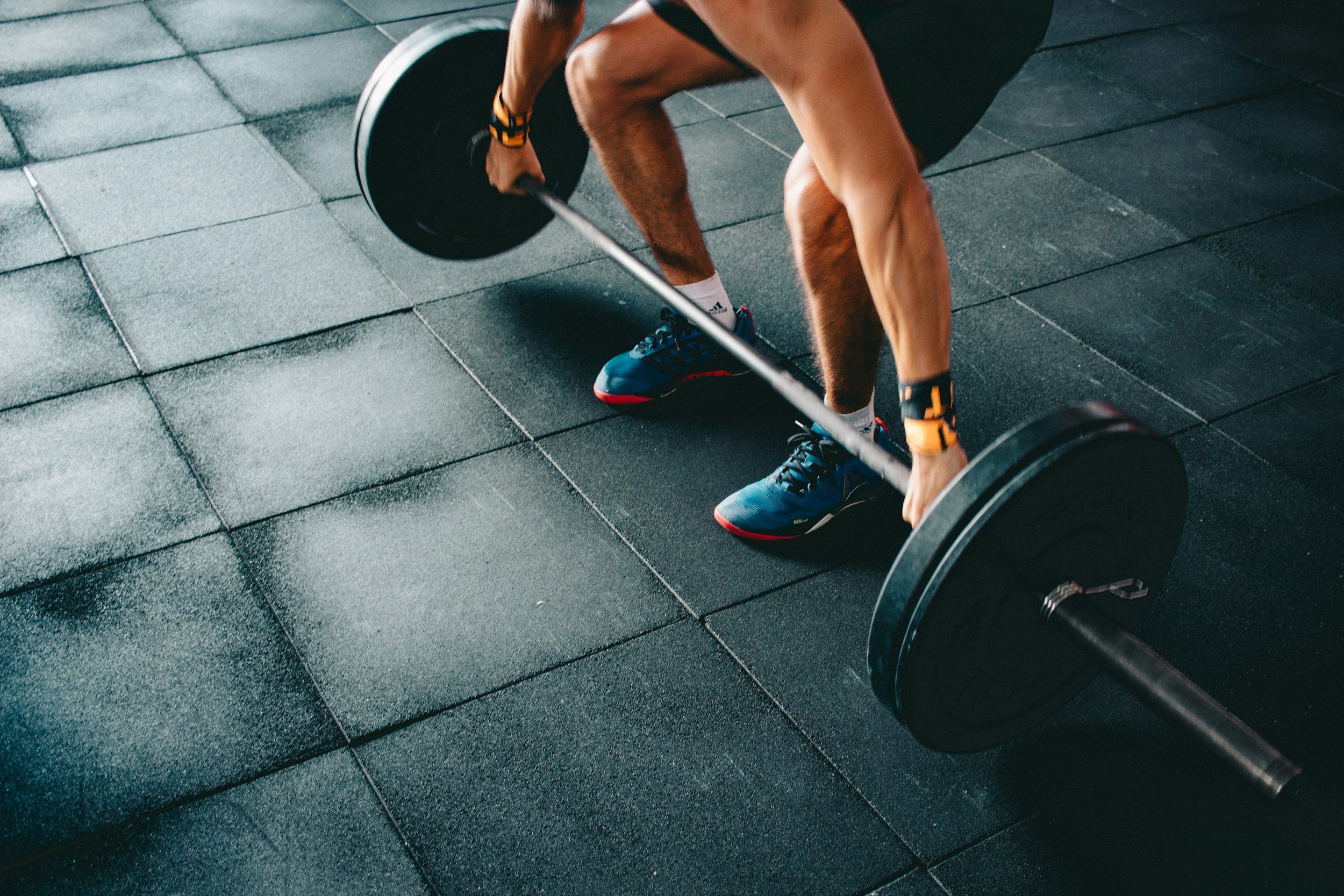
An overarched back can be seen at the start/set up position or at the top of the deadlift as shown in the picture above. Instead of getting the stability from the gluteus maximus (the largest glute muscle we have), an athlete will arch their back to stand up tall.
How to fix this mistake: Engage the glutes.
To correct this form, push your feet into the ground and stand tall until your body is in line in the torso, ribcage, and pelvis. This will help keep your back straight during deadlifts.
Fault #2: Knees Cave In
Knee caving (also called knee valgus) is when your knees cave inward during your deadlifts. This can lead to potential injury of the knees, and can even lead to issues in other parts of the body.
How to fix this mistake: Grip the ground with your feet.
To correct your form and avoid this mistake, focus on gripping the ground with your feet during your deaddlifts. By gripping the ground with the feet, an athlete can also drive the knees out slightly, allowing for external rotation (and development of torque) of the hip muscles. By properly engaging the glutes you can optimize your training to promote growth of the glute muscles.
Fault #3: Squat vs Hinging
In this case, athletes will have their butt low when pulling the weight off the ground while the hips and knees move together. Then, they then bend their knees early during the descent and squat the weight to the floor, leading to bad deadlift form.
How to fix this mistake: Hinge at your hips.
Hinge at the hip during the descent until the top of the knees are almost parallel with the hips before bending knees to lower the weight. After this point, the back angle should remain about the same until the weights hit the ground.
Fault #4: Not Bending The Bar
With this deadlift mistake, an athlete will have the bar far away from them, which makes it challenging to lift anything heavy (due to physics-long lever arm). They will not engage their lats (the big bat wing muscles).
How to fix this mistake: Bend the bar!
You may have heard this cue before. What does it actually do?
By engaging the motion of external rotation in the shoulder and recruiting the muscle groups that support the shoulder, you can get the most out of your deadlifts.
This motion transfers most closely to the foundational strength and skill of the clean and jerk and the snatch. Additionally, the recruitment of the muscle group surrounding the shoulder, especially the rotator cuff, helps improve skills and movements like pull ups, muscle ups, dips, toes to bar, overhead press, overhead squat, bench press, etc.
Fault #5: Mixed Grip
We have this common deadlift mistake noted with a question mark because it is a good mistake to discuss for two reasons:
1) Lack of grip strength.
With the mixed grip, you could be missing out on the force production from one side of the back musculature (especially from the lats).
2) Lack of transfer to other skills.
There aren’t many times where you use a mix grip to perform olympic weightlifting. Although there are times where practicing different grip positions is good for varying movements, in general, practicing more similar grips to the movements you will be doing in regular workouts may help. Especially a regular grip and a snatch grip.
A physical therapist specializing in sports conditioning can help incorporate grip strength training into your routine. If you feel like your grip is the missing link during the deadlift. There are great ways to train grip strength, such as:
1) Using the thumb and evaluate your grip. Are you using a hook grip?
2) Perform a bottoms up kettlebell carry.
3) Hold heavier loads (at higher percentages) for longer using the time under tension principle.
Improve Your Deadlift Form
Looking for ways to improve your deadlift technique? Contact us today. With the help from our Las Vegas Physical Therapy clinic, we can help you correct your deadlift form and avoid these common mistakes listed above.
Schedule a free consultation
Get back to doing what you love, completely pain-free. Take the first step and schedule a free 15-minute phone consultation with a member from our Las Vegas physical therapy clinic.