
Postpartum Return to Exercise: Pelvic Floor Checks First
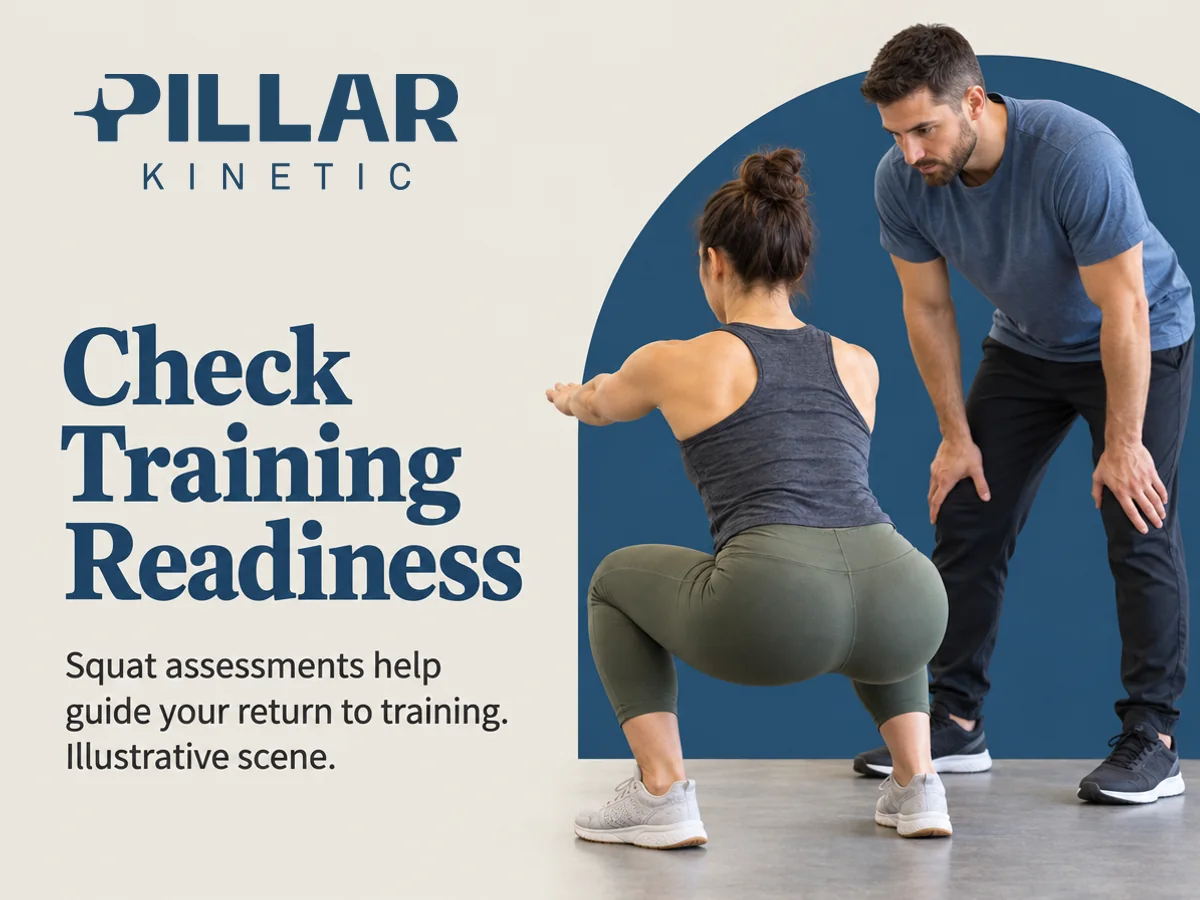
It is not the same as being ready to run, jump, or lift heavy again. Your body just did something enormous, and the pelvic floor and deep core usually need a bit of rebuilding before impact and big loads come back.
In this article
- What to check before hard training
- A step-by-step return
- Breathing and pressure come before "core"
- Build impact slowly
- Strength before high-intensity circuits
- C-section recovery
- Leaking is a signal
- Abdominal separation without panic
- The things nobody mentions
- Mistakes we see often
- When to call your doctor
- How Pillar can help
- FAQ
Related care
Postpartum physical therapy in Las Vegas
Your clearance appointment was only a starting point.
Book appointmentThe return goes more smoothly when a few things get checked first. Here is what we look at, a simple order for building back up, and the signs that mean you should pause.
What to check before hard training
| Check | Why it matters |
|---|---|
| Bleeding or pain that has not settled | You may still need medical follow-up before training |
| Leaking with a cough, sneeze, run, or lift | A coordination or strength gap that is easier to fix early |
| Heaviness, pressure, or a bulging feeling | Should be screened for prolapse by a qualified clinician |
| Your belly domes or cones during core work | A sign to change how you manage pressure and load |
| How your C-section or perineal scar moves | Affects comfort and how much load you can tolerate |
| Sleep and how well you are eating | Under-recovered bodies backslide quickly |
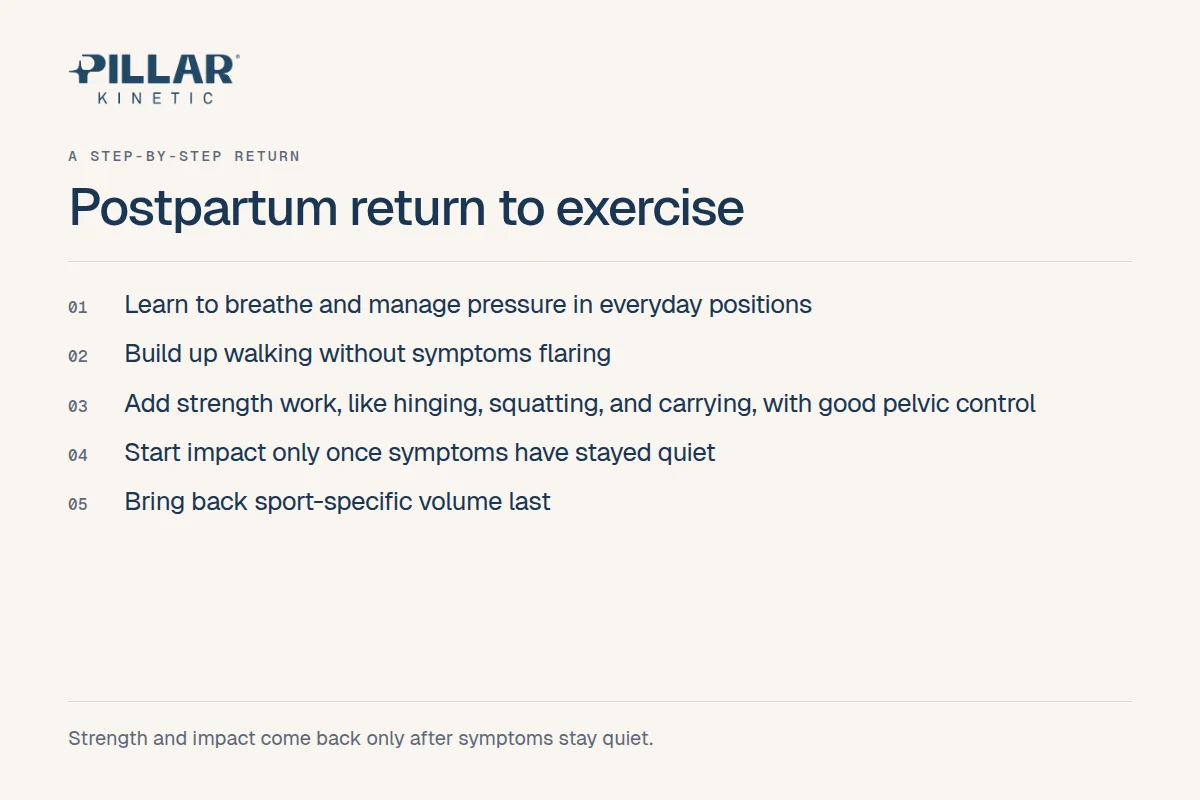
A step-by-step return
- Learn to breathe and manage pressure in everyday positions
- Build up walking without symptoms flaring
- Add strength work, like hinging, squatting, and carrying, with good pelvic control
- Start impact only once symptoms have stayed quiet
- Bring back sport-specific volume last
How fast you move through these steps depends on how you delivered, whether there was tearing or an assisted delivery, and how your body responds. Your OB or midwife clears you medically first. Then a pelvic floor physical therapist can help you build the plan.
Breathing and pressure come before "core"
It is tempting to jump straight to planks and crunches. If lifting the car seat, standing up from the couch, or pushing the stroller up a driveway brings on leaking or pressure, harder core work will too. Start by learning to manage pressure in those daily tasks. Once that feels solid, your PT can load it with you.
Build impact slowly
Walking comes before jogging. Short run-walk intervals come before longer runs. Hills and speed come last. If leaking or heaviness comes back when you add volume, treat it as information, not failure. Step back a level, work on the gap, then move forward again. If you have a race or season on the calendar, share the date so the plan is realistic.
Las Vegas summers add another wrinkle. Early morning or indoor sessions help, and dehydration can make fatigue and symptoms feel worse.
Strength before high-intensity circuits
Hinges, squats, carries, and pushing movements done with good pelvic control give you a foundation for almost any sport. Jumping into Olympic lifts or high-rep circuits while symptoms are loud is a common setback. Ask your PT which symptoms mean stop and which mean adjust.
C-section recovery
Your scar and abdominal wall affect how loaded core work feels in the early months. Pain, pulling, or numbness around the scar deserves a clinical look. Do not push into sharp pain because a program says it is the right week.
Leaking is a signal
Leaking with a cough, sneeze, jump, or heavy lift tells you something. It does not mean you are broken, and it is not something to ignore until race day. Working on coordination and loading early keeps it from becoming something you train around for years. A short log helps at your first visit: what you were doing, how much leaking or heaviness, and how long it lasted.
Abdominal separation without panic
Changes in the abdominal wall are very common after pregnancy. Doming during a sit-up is a cue to change strategy, not a reason to fear movement. Skip programs that promise a flat stomach quickly while ignoring the pelvic floor. Our page on diastasis recti explains how PT approaches it.
The things nobody mentions
Too little sleep and too little food make it hard for any body to adapt to training. Mention night feedings and your eating habits at your consult. A plan that ignores recovery is incomplete no matter how good the exercises look.
Childcare matters too. Three exercises you will actually do beat a perfect routine you never get to.
Mistakes we see often
- Starting to run right after the postpartum checkup because you were "cleared"
- Doing sit-up challenges while leaking or doming
- Treating exhaustion as a willpower problem
- Picking up your old pre-pregnancy program without pressure work first
- Avoiding PT because the symptoms feel embarrassing
When to call your doctor
Heaviness or a bulge that is getting worse, pain that increases week to week with basic activity, fever or concerns about a wound, or sudden heavy bleeding are medical issues first. Physical therapy picks back up once those are handled. Keep your OB or midwife and your PT in the loop when symptoms change.
How Pillar can help
Pillar Kinetic offers postpartum pelvic floor therapy in Las Vegas that turns "return to exercise" into specific, measurable steps based on your delivery, your symptoms, and your goals. To learn more about the team, visit our physical therapy clinic in Las Vegas.
FAQ
Is my postpartum checkup a green light for running?
It is an important medical check-in, but it is not a guarantee you are ready for impact or heavy lifting.
Can I just do Kegels and skip PT?
Not always. Some pelvic floors are too tight rather than too weak and need to learn to relax before they get stronger.
When should I book PT compared with my medical clearance?
Ask both your OB and your PT. Many people start with education and gentle work around the time they are cleared, then add load as symptoms allow.
I want to get back to CrossFit or distance running. Anything different?
Mention it early. High-impact and high-pressure sports usually need a longer ramp. Symptom-free walking and strength work come first.