
How Men Can Relax a Tight Pelvic Floor (and Why Kegels Are Not Always the Fix)

For some men that is reasonable. For others it makes things worse.
In this article
- Weak vs tight: why the difference matters
- Signs your pelvic floor may be holding tension
- Step one: find the muscles before you try to relax them
- Breathing is the main tool
- Positions that make letting go easier
- Daily habits that keep tension going
- When Kegels might still be part of the plan
- When to see a pelvic floor physical therapist
- FAQ
Related care
Pelvic floor physical therapy for men in Las Vegas
Men have a pelvic floor too.
Book appointmentThe pelvic floor is a group of muscles that sit at the base of the pelvis and wrap around the bladder, bowel, and prostate. Like any muscle, they can be weak. They can also be stuck in a held, tense state that never fully lets go. Squeezing harder does not help a muscle that is already working overtime.
This post covers how to tell if tension might be part of the picture, a few low-risk ways to practice relaxing, and when it makes sense to have a pelvic floor physical therapist take a look.
Weak vs tight: why the difference matters
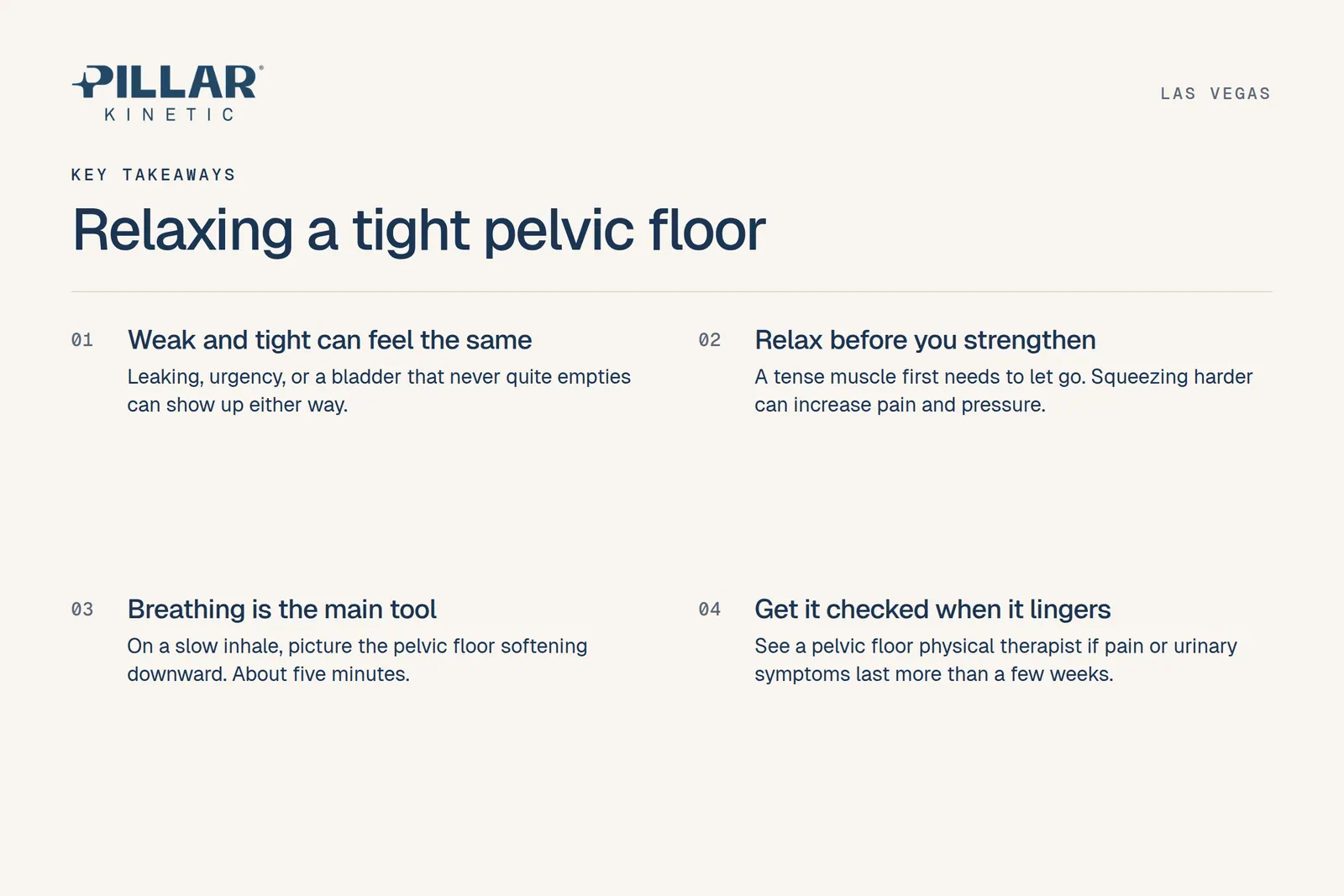
A weak pelvic floor and an overactive one can produce some of the same symptoms, which is why guessing is a problem. Leaking, urgency, or a feeling that the bladder never quite empties can show up either way.
The difference is in what the muscles need. A weak muscle needs strength. A tense muscle first needs to learn to relax and lengthen, and then to contract with good timing. Adding strength work on top of tension can increase pain and pressure.
Signs your pelvic floor may be holding tension
None of these confirm anything on their own, but they are worth noticing:
- An ache in the perineum, tailbone, groin, or tip of the penis, especially after sitting
- Burning or urgency that looks like an infection, but tests come back clear
- A slow start to urination, a weak stream, or dribbling after you finish
- Pain with or after ejaculation
- Constipation or straining with bowel movements
- Symptoms that flare during stressful stretches at work or home
- A habit of clenching your glutes, abs, or jaw without realizing it
If several of these sound familiar, tension is a reasonable thing to explore.
Step one: find the muscles before you try to relax them
It is hard to let go of something you cannot feel. Sit on a firm chair and imagine stopping the flow of urine, or lifting the base of the pelvis up and in. That gentle lift is the pelvic floor contracting.
Now let it drop. Notice whether it actually releases or stays a little lifted. Many men with tension find the "let go" half is the part that feels unfamiliar. That is the skill to practice.
Breathing is the main tool
The diaphragm and the pelvic floor move together. When you inhale deeply, the diaphragm moves down and the pelvic floor should lengthen and drop slightly. When you exhale, both rise back up.
Try this once or twice a day:
- Lie on your back with knees bent, or sit with your feet flat.
- Put one hand on your belly and one on your lower ribs.
- Breathe in slowly through your nose so your belly and ribs widen.
- As you inhale, picture the sit bones spreading apart and the pelvic floor softening downward.
- Exhale slowly through your mouth and let everything return without pushing.
- Repeat for about five minutes.
The goal is not a big effort. It is a slow, quiet breath with a relaxed belly.
Positions that make letting go easier
Some positions open the hips and take load off the pelvic floor, which can make relaxation easier to feel:
- Child's pose: Knees wide, hips back toward the heels, arms forward. Breathe into the back of the pelvis.
- Happy baby: On your back, knees toward your armpits, holding your feet or shins. Let the tailbone stay heavy.
- Supported deep squat: Hold a counter or doorframe and sink into a squat as far as is comfortable, heels on the floor or on a rolled towel.
Combine any of these with the breathing above. Stop if a position causes sharp pain.
Daily habits that keep tension going
Small habits add up. A few to watch:
- Bracing all day: Holding the stomach in or squeezing the glutes while standing keeps the pelvic floor engaged too.
- Straining on the toilet: Pushing hard to urinate or move the bowels works against the muscles. A footstool under the feet and slow breathing can help.
- Hovering or rushing: Going "just in case" or rushing to finish can train the bladder and pelvic floor into bad patterns.
- Long hours sitting: Desk work, driving, or cycling can add pressure. Short standing breaks help.
- Stress: Many people tighten the pelvic floor the same way they tighten their shoulders. Noticing it is the first step.
When Kegels might still be part of the plan
Kegels are not bad. They are simply one tool. Men recovering from prostate surgery, for example, often need targeted strengthening. Even then, a muscle that can fully relax tends to strengthen better than one that never lets go. The order matters, which is why a proper assessment is useful before you commit to a routine.
When to see a pelvic floor physical therapist
Self-care helps many men notice and reduce tension. It is not a substitute for an evaluation if symptoms persist. Consider booking a visit if:
- Pain or urinary symptoms have lasted more than a few weeks
- Antibiotics for suspected prostatitis did not help
- You are preparing for or recovering from prostate surgery
- Sexual symptoms are affecting your life and your physician has ruled out other causes
At Pillar Kinetic, a pelvic floor evaluation is one-on-one with the same therapist for the full hour. Our men's pelvic floor therapy in Las Vegas is led by Dr. Minija Edgar, PT, DPT, WCS, and focuses on the muscles, connective tissue, and nerves involved. If you are not sure where to start, our physical therapy clinic in Las Vegas can help you decide whether a pelvic floor visit is the right first step.
See your physician promptly for fever, blood in the urine, inability to urinate, or sudden severe pain. Those need medical care first.
FAQ
Do men really have a pelvic floor?
Yes. Men have the same basic group of pelvic floor muscles as women, supporting the bladder and bowel and surrounding the prostate. They can become weak, tense, or poorly coordinated.
Can a tight pelvic floor cause pain that feels like prostatitis?
It can. Many men with burning, urgency, and perineal aching have no active infection. Tight or overactive pelvic floor muscles are a common contributor.
How long does it take to learn to relax the pelvic floor?
It varies. Some men notice a difference in a few weeks of daily breathing practice. Others need hands-on treatment and a guided plan.
Is pelvic floor therapy for men offered in Las Vegas?
Yes. Pillar Kinetic in northwest Las Vegas, near Summerlin, treats men for pelvic pain, bladder symptoms, sexual function concerns, and recovery after prostate surgery.
Does Pillar Kinetic take insurance?
No. Pillar Kinetic is a cash-based clinic and does not take insurance, Medicare, or Tricare. Call for current visit pricing.